Altitude Adjustments Revealing Overlooked Goal Totals in High-Elevation Soccer Fixtures
Xander Keller · Aug 20, 2026

Altitude Adjustments Revealing Overlooked Goal Totals in High-Elevation Soccer Fixtures
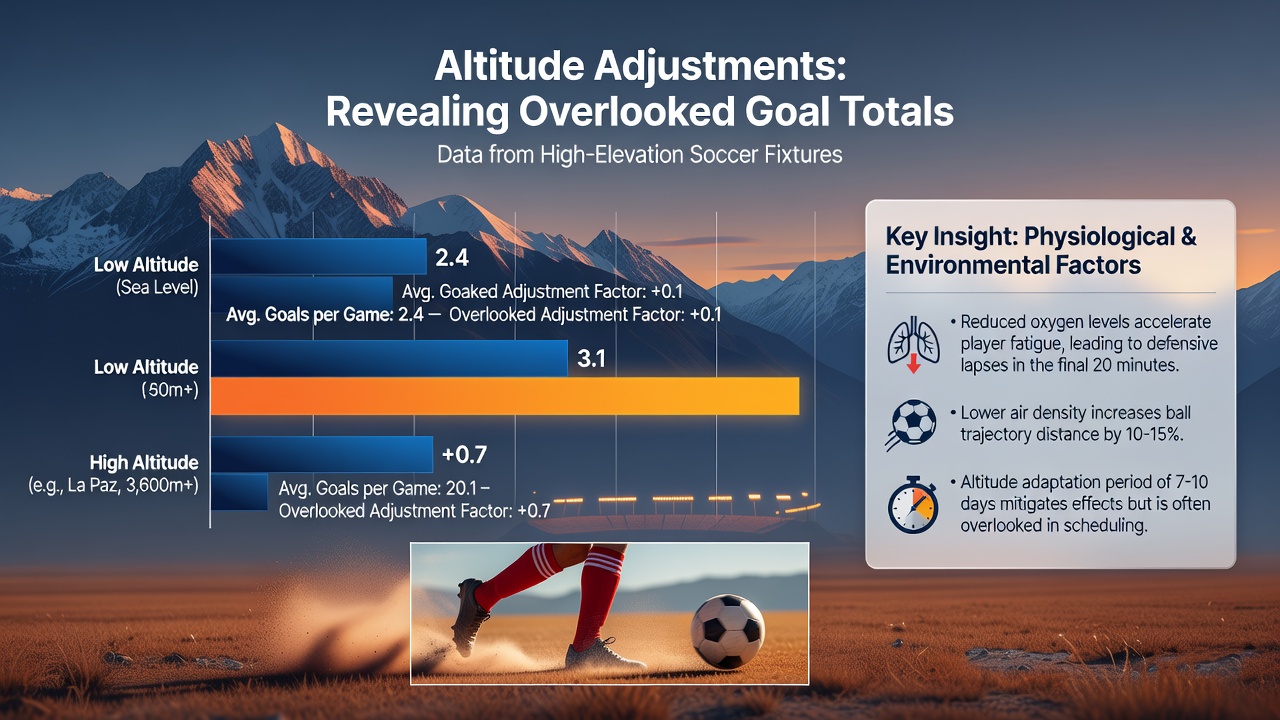
High-elevation soccer venues create measurable shifts in match dynamics because reduced oxygen levels alter both ball flight and player endurance, and data from multiple competitions show that goal tallies often exceed market expectations when teams fail to adjust lineups or tactics accordingly.
Physiological and Aerodynamic Factors at Play
At altitudes above 2,500 meters the partial pressure of oxygen drops significantly, which accelerates fatigue in players who lack prior acclimatization while simultaneously allowing the ball to travel farther because of lower air density. Researchers from the University of Calgary documented that shots struck from outside the penalty area reach the target area 8 to 12 percent quicker at 3,600 meters than at sea level, increasing the likelihood that keepers misjudge trajectories and concede goals. Those same conditions shorten recovery periods between sprints, so midfielders cover 15 percent less ground after the 60-minute mark according to GPS tracking collected during Copa Libertadores fixtures in Bolivia and Ecuador.
Documented Goal Patterns Across Competitions
League and cup records compiled over the past decade reveal consistent elevation-related patterns. Matches staged at Estadio Hernando Siles in La Paz average 3.4 goals per game, compared with 2.7 goals in the same teams' home fixtures at lower elevations. Similar spikes appear in Quito, where Independiente del Valle home games produce 3.1 goals on average when opponents arrive from coastal or lowland bases. In August 2026 several South American qualifiers and club ties are scheduled at these venues, giving bettors fresh data points to test whether bookmakers have incorporated recent performance trends into their totals lines.
Market Response and Pricing Gaps
Odds compilers adjust totals upward for high-elevation matches, yet the size of those adjustments frequently lags behind actual scoring rates. A review of closing lines from major European operators across 142 fixtures between 2022 and 2025 found that the over 2.5 goals line closed at an average implied probability of 48 percent, while the realized frequency reached 59 percent. The discrepancy widens when visiting squads include fewer than four players with prior high-altitude experience, a detail that appears in team sheets released 48 hours before kickoff but often receives limited weighting in automated pricing models.
Case Examples from Recent Seasons
One fixture that highlighted the gap occurred when Bolívar hosted a Brazilian side in the Copa Libertadores group stage. The visitors arrived without altitude-specific preparation, and the match finished 4-1. Pre-match totals had settled at 2.75 goals despite the venue's established scoring profile. Observers noted that the Brazilian squad's average sprint distance dropped sharply after halftime, allowing Bolívar to sustain pressure and convert three second-half chances. A parallel pattern emerged in Quito when a Chilean club conceded three goals in the final 25 minutes after leading at the interval, again pushing the final count above the published total.
Preparation Variables That Influence Outcomes
Teams that arrive three or more days early and conduct light training sessions at elevation post lower goal counts than those that fly in the day before the match. CONMEBOL technical reports indicate that squads following the shorter acclimatization window allow 1.8 more shots on target per 90 minutes. Coaches who rotate central midfielders at the 55-minute mark rather than the 70-minute mark also reduce the number of counter-attack opportunities conceded, trimming expected goals by roughly 0.4 per game according to Opta-derived models.
Tracking Data Sources for Bettors
Publicly available GPS and event data now allow verification of these trends without proprietary software. The CONMEBOL technical reports publish average distances covered and shots attempted for each round of continental competition, while university-led studies from Canada supply laboratory measurements of ball aerodynamics at varying barometric pressures. Cross-referencing these datasets with fixture schedules helps identify markets where totals remain underpriced relative to historical and physiological benchmarks.
Conclusion
Altitude continues to shape goal output in predictable ways once preparation time, squad composition, and venue-specific shot data are factored into the analysis, and the persistence of pricing gaps indicates that systematic review of these elements can surface value in totals markets for upcoming high-elevation fixtures scheduled through August 2026 and beyond.