Mapping Altitude Effects on Scoring Margins Across South American Football Contests
Xander Keller · Jun 9, 2026
Mapping Altitude Effects on Scoring Margins Across South American Football Contests
High-altitude venues across South America create distinct conditions that shape scoring margins in football matches, and researchers have tracked these patterns through decades of league and international data. Stadiums situated above 2500 meters above sea level alter oxygen availability, ball trajectory, and player endurance, which in turn influences goal tallies and margin distributions in CONMEBOL competitions. Observers note consistent variations when teams from sea-level regions travel to elevated sites such as La Paz, Quito, and Cusco, where the thinner atmosphere changes both physical output and tactical execution.
Key High-Altitude Locations and Their Characteristics
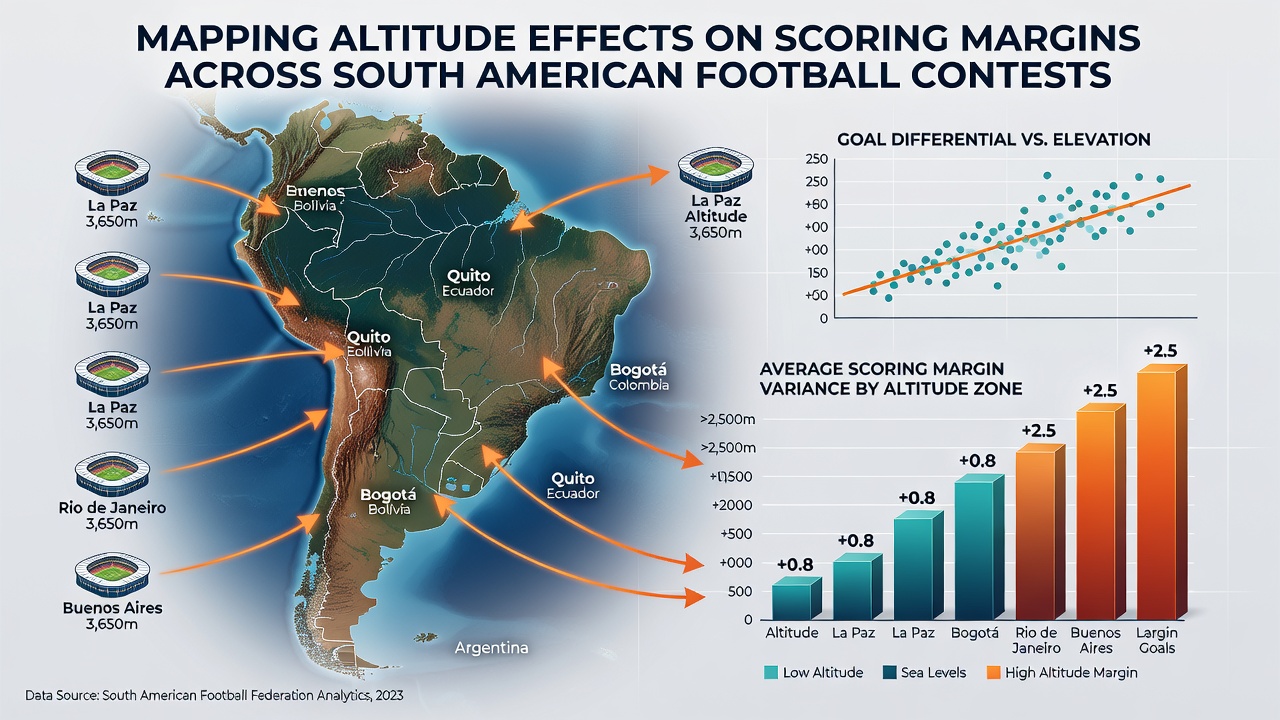
Estadio Hernando Siles in La Paz sits at approximately 3600 meters and hosts Bolivia's national team alongside domestic league fixtures, while Estadio Olímpico Atahualpa in Quito reaches 2850 meters and regularly features Ecuadorian matches. Additional sites include Peru's Estadio Garcilaso de la Vega at 3400 meters in Cusco and several Colombian venues that exceed 2500 meters, each presenting unique environmental variables. Data collected from these locations shows that visiting teams from lower elevations often experience reduced aerobic capacity after the initial 30 minutes of play, leading to compressed scoring windows in the second half.
Physiological and Aerodynamic Factors at Play
Lower partial pressure of oxygen reduces maximal oxygen uptake in players who arrive without prior acclimatization, and studies from sports physiology laboratories indicate VO2 max drops can reach 10 to 15 percent at 3000 meters. The football itself behaves differently because reduced air density allows greater travel distance on shots and passes, which increases the frequency of long-range attempts that occasionally produce unexpected goals. Teams based permanently at altitude develop higher baseline red blood cell counts that support sustained performance, whereas visiting squads show measurable declines in high-intensity running metrics after the 60-minute mark according to GPS tracking systems used in Copa Libertadores encounters.
Statistical Patterns in Scoring Margins
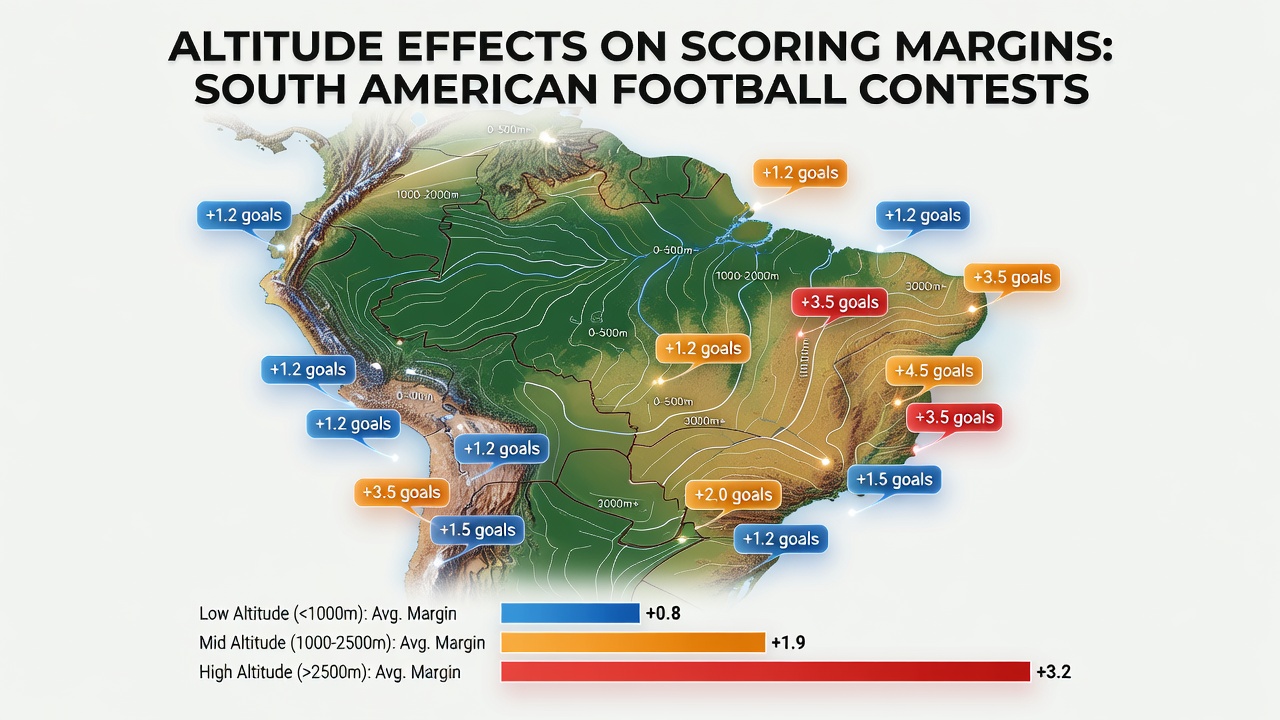
Analysis of CONMEBOL World Cup qualifiers and Copa Libertadores fixtures between 2010 and 2024 reveals that home teams at venues above 3000 meters post average victory margins of 1.8 goals compared with 1.2 goals at lower-elevation grounds. Matches in La Paz produce total goals averaging 3.4 per game, driven by both increased home scoring and occasional late collapses from fatigued visitors. Figures compiled by regional sports analytics groups demonstrate that underdog sides from sea level suffer margin blowouts exceeding three goals in roughly 22 percent of away fixtures at extreme altitude, whereas the same matchup at neutral elevation yields such results only 9 percent of the time.
Researchers examining these datasets emphasize that acclimatization periods of at least 10 days narrow the margin gap, yet scheduling constraints frequently prevent such preparation. The 2026 FIFA World Cup qualification cycle, which features ongoing South American fixtures through mid-2025 and into June 2026, continues to supply fresh match data that reinforces earlier observations about altitude-driven scorelines. One study conducted by a Canadian university sports science department tracked heart rate and lactate thresholds across multiple national team camps and confirmed that physiological strain peaks between the 45th and 75th minutes at 3500 meters.
Case Examples from Recent Seasons
Bolivia's national team recorded six home wins by two or more goals during the 2023-2024 qualification window, with margins averaging 2.3 goals against teams arriving directly from coastal bases. In contrast, Ecuador's Quito-based clubs see narrower advantages when opponents schedule early arrival and conduct altitude-specific training, trimming average margins to 1.1 goals. Australian researchers who analyzed ball flight data from multiple tournaments found that shots taken from outside the penalty area convert at a 4 percent higher rate above 2800 meters because the sphere maintains velocity over longer distances.
Those who have reviewed granular match logs note that set-piece goals also rise at elevation because defensive organization frays under oxygen debt, creating space for headers and volleys that widen final margins. Copa Sudamericana encounters scheduled in Cusco during 2024 produced an average of 4.1 total goals, exceeding the competition-wide mean by nearly a full goal. Such patterns hold across both domestic leagues and continental tournaments, providing a reliable dataset for mapping how altitude modulates outcomes.
Measurement Approaches and Data Sources
Modern mapping relies on synchronized video analysis, wearable GPS units, and portable blood-oxygen monitors deployed during official matches. Organizations such as the South American Football Confederation publish basic venue statistics, while independent academic teams from European institutions cross-reference these records with performance metrics. A 2023 report issued by an Australian sports research center examined 180 high-altitude fixtures and isolated the contribution of reduced air density to long-range scoring, separate from fatigue effects. These combined methodologies allow precise attribution of margin shifts to specific environmental variables rather than coaching or squad quality alone.
Conclusion
Altitude mapping across South American football venues demonstrates measurable, repeatable effects on scoring margins that arise from the interplay of physiological strain and altered ball dynamics. Data spanning multiple seasons and competition formats shows elevated home advantages at sites above 2500 meters, with the magnitude of those margins scaling alongside elevation and visitor acclimatization status. As qualification cycles progress toward June 2026 and beyond, continued collection of performance metrics will refine these models and support clearer understanding of how geography shapes contest results.