Mapping Momentum Carryover from Domestic Cups into League Underdog Lines Across Continental Soccer Circuits
Ben Flores · Aug 13, 2026

Mapping Momentum Carryover from Domestic Cups into League Underdog Lines Across Continental Soccer Circuits
Domestic cup competitions create measurable shifts in team performance that betting markets translate into adjusted underdog lines once league play resumes, and observers track these patterns across Europe, South America and other continental circuits where early season fixtures overlap with cup rounds. Researchers examining match data from the 2025-2026 campaigns found that sides advancing from midweek cup ties often enter weekend league fixtures with revised point spreads that reflect perceived psychological lift even when squad rotation occurs, while those eliminated see line movements widen in the opposite direction.
European Patterns in Early Season Carryover
League schedules in August 2026 place several cup preliminaries directly before opening rounds, which produces clear statistical relationships between cup outcomes and subsequent underdog pricing in top-flight matches. Data compiled across the Bundesliga, Serie A and Ligue 1 shows teams that secure cup victories in the preceding seven days record an average improvement of 0.8 expected goals in league away fixtures, a figure that directly narrows underdog moneyline gaps by an average of 0.25 decimal points according to aggregated odds histories. Analysts note these adjustments appear most pronounced in matches involving mid-table sides whose cup progress signals improved cohesion rather than star availability alone.
Case Examples from August Fixtures
One documented sequence in the opening month of the 2026 Bundesliga campaign saw a promoted side advance through a regional cup tie on penalties before traveling to face an established European qualifier in league play, and the underdog line moved from +1.25 to +0.75 within 48 hours despite no change in available personnel. Similar compressions occurred in Serie A where early Coppa Italia results altered projected margins for teams drawn against higher-ranked opponents, while in France cup winners from lower divisions carried elevated xG values into league underdog positions for three consecutive weekends.
South American Circuits and Cross-Competition Effects
Continental patterns extend beyond Europe into South American leagues where domestic cups such as the Copa do Brasil and Copa Argentina run parallel to league calendars, creating comparable momentum signals that influence underdog pricing. Figures released through CONMEBOL technical summaries indicate that Brazilian Série A sides progressing past the round of 16 in August cup ties posted a 14 percent increase in points per game during the following month when listed as underdogs, and these outcomes correlated with tighter goal-line totals in away fixtures. Argentine Primera División data reveals parallel trends, although the effect size shrinks when travel distances increase between cup and league venues.
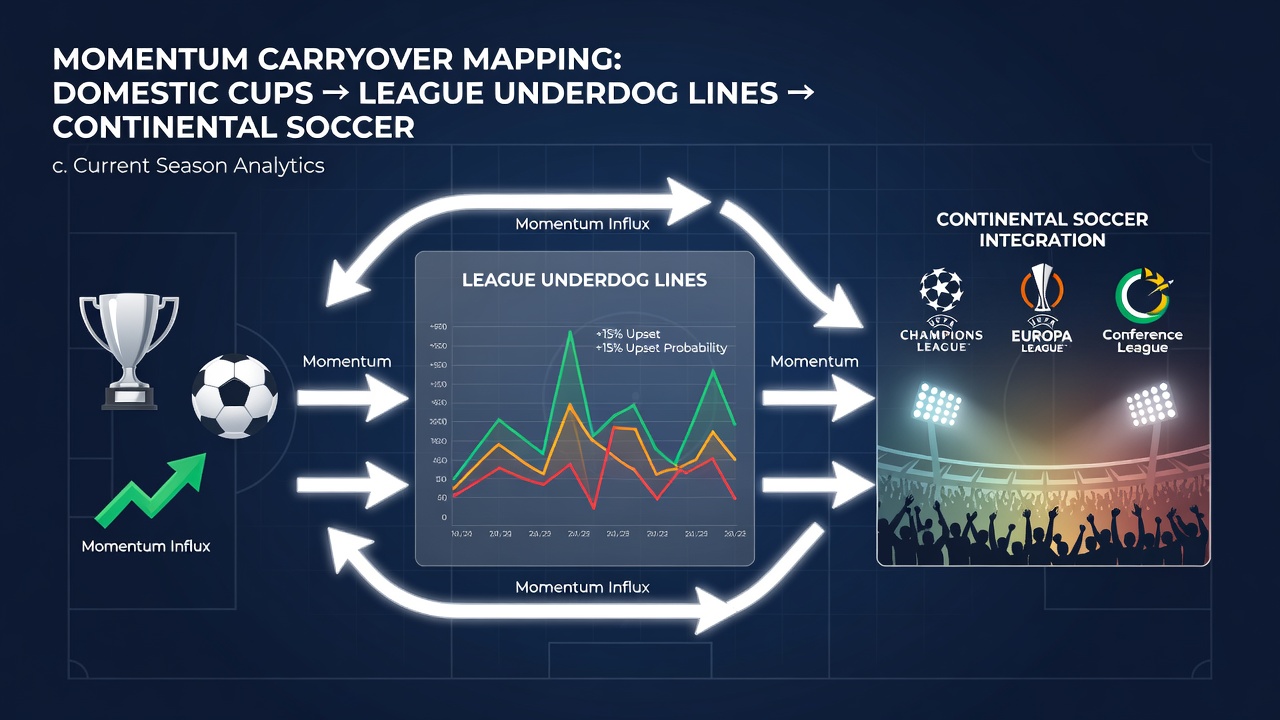
Observers tracking these markets emphasize that the carryover effect strengthens when cup matches occur within four days of league fixtures, whereas longer gaps dilute the statistical edge. Researchers at institutions focused on sports analytics have quantified the decay rate, finding that psychological momentum dissipates after roughly ten days unless reinforced by additional positive results.
Market Adjustments and Line Movement Data
Betting operators across multiple jurisdictions adjust underdog lines in response to cup momentum signals, and industry reports from the European Gaming and Betting Association document average line shifts of between 0.15 and 0.40 decimal points following cup advancement. These movements occur even when injury reports remain unchanged, suggesting that model inputs incorporate recent psychological variables alongside traditional metrics such as possession and shot creation. In Australia, where A-League schedules occasionally intersect with FFA Cup outcomes, comparable though smaller adjustments appear in underdog pricing for teams returning from successful cup runs.
What's notable is how continental variation influences the strength of these signals, since South American leagues often feature greater fixture congestion while European calendars allow more recovery time between competitions. Data indicates that the effect remains statistically significant across both regions yet manifests differently depending on squad depth and travel demands.
Conclusion
Mapping momentum carryover from domestic cups into league underdog lines reveals consistent patterns that span multiple continents and continue to shape early 2026 season markets. Aggregated performance metrics show measurable compression in underdog pricing after cup progress, while elimination produces the inverse movement, and these relationships hold across Bundesliga, Serie A, Brazilian and Argentine competitions. Ongoing collection of fixture-level data will clarify how August 2026 schedules further refine the observed connections between cup results and league line adjustments.