Travel schedules reshaping away performance metrics in continental tournaments
Xander Ludwig · Aug 11, 2026

Travel schedules reshaping away performance metrics in continental tournaments
Travel schedules have altered how performance metrics register for away teams in continental tournaments, where distances stretch across time zones and continents rather than domestic borders. Data compiled from major competitions shows consistent shifts in away-side statistics once flight durations exceed six hours, with changes appearing in possession retention, high-intensity running output, and conversion rates on set pieces. Researchers tracking UEFA and CONMEBOL events over multiple seasons note these patterns emerge regardless of squad depth or pre-match preparation routines.
Distance and recovery windows in intercontinental fixtures
Continental tournaments place clubs on routes that domestic leagues rarely demand, and the resulting compression of recovery time leaves measurable traces in match data. Teams crossing the Atlantic for Copa Libertadores group stages or returning from AFC Champions League fixtures in Asia record drops in distance covered during the first half, according to tracking systems used by competition organizers. The effect compounds when return flights occur within 48 hours of the away fixture, limiting full physiological restoration before the next domestic commitment. Observers note that recovery windows under 72 hours correlate with elevated error rates in passing accuracy for away sides, while longer layovers allow metrics to stabilize closer to home-game baselines.
Time-zone shifts and their statistical footprint
Crossing multiple time zones disrupts circadian rhythms, and performance databases now capture the downstream consequences for continental away matches. Eastward travel of four or more zones tends to produce sharper declines in sprint frequency during the opening 30 minutes, whereas westward journeys show slower but sustained reductions in late-match intensity. Figures released by tournament statisticians indicate that teams arriving from a four-zone difference average 12 percent fewer successful tackles in the final 15 minutes compared with neutral-zone opponents. These patterns hold across age groups and competition levels, suggesting the underlying physiological load remains consistent even when coaching staffs adjust rotation policies.
Case examples from recent tournament cycles
One documented instance involved a European side traveling to a South American venue for a midweek fixture, then returning for a weekend domestic fixture. Tracking data revealed a 9 percent reduction in total distance covered and a 15 percent drop in aerial duel success relative to the team's season average for away games within Europe. Another case from an Asian club competing in an intercontinental group stage showed similar compression of high-speed running metrics after a 10-hour flight plus an immediate turnaround. Tournament reports list these adjustments without attributing them to any single factor, yet the scheduling sequence appears repeatedly in the datasets.
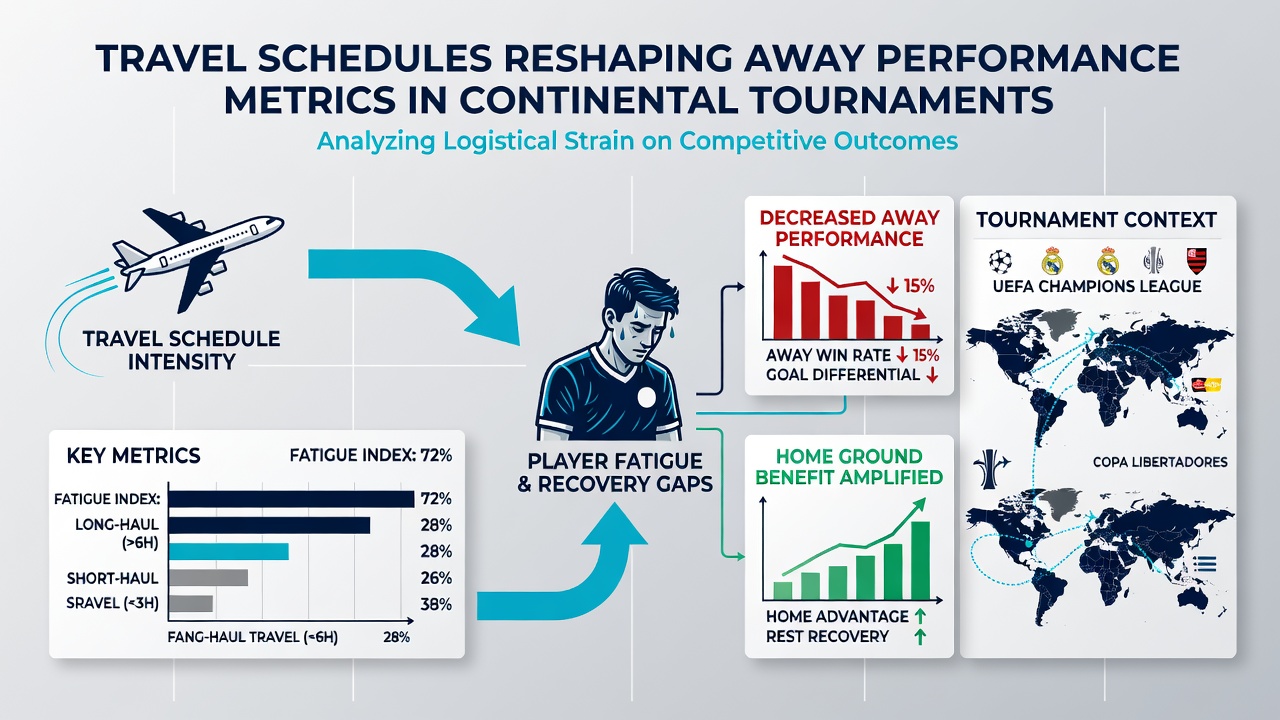
August 2026 brings additional scheduling pressure because several continental qualification windows overlap with pre-season calendars in both hemispheres. Clubs already committed to expanded club competitions must navigate tighter flight windows around international breaks, and early modeling from scheduling analysts projects further compression of recovery periods. Data from previous overlapping windows demonstrates that away performance metrics in those periods diverge most noticeably in the second half, where accumulated fatigue compounds the initial travel load.
Metric categories most sensitive to travel
Goal-line technology and optical tracking systems now isolate specific categories that respond first to extended travel. Away teams show reduced pass completion inside the opposition box and lower expected-goal values from open play, while set-piece conversion sometimes remains stable because those actions require less sustained movement. Defensive metrics such as interceptions per 90 minutes decline more sharply after westward long-haul flights than after shorter intra-continental hops. Aggregated figures across five seasons of continental group play confirm that these category-specific shifts occur before overall match outcomes register as statistically different.
League and confederation responses
Organizers have begun publishing supplementary scheduling guidelines that reference travel duration as a variable in fixture planning. FIFA medical documents and reports from the FIFA technical department outline recommended rest intervals scaled to flight length, while the Asian Football Confederation has adjusted certain kick-off times to accommodate recovery. European confederation calendars incorporate similar buffers for clubs with intercontinental commitments, although enforcement remains at the discretion of individual national associations. These adjustments aim to stabilize the performance metrics that tracking systems record, rather than to alter competitive balance directly.
Analytical tools used by performance staff
Performance departments now integrate flight data with GPS and heart-rate variability readings to forecast metric drift before kick-off. Software platforms combine historical away-game outputs with real-time recovery scores, producing probability ranges for key indicators such as high-intensity efforts and duel success. One study published in a sports-science journal examined 120 continental away fixtures and found that incorporating travel variables improved the accuracy of pre-match projections by roughly 8 percentage points. Clubs that apply these layered models adjust training loads accordingly, yet the underlying metric shifts still appear in post-match summaries released by tournament statisticians.
Conclusion
Travel schedules continue to influence away performance metrics across continental tournaments through measurable changes in physical output and technical execution. Data from multiple confederations shows these effects concentrate in specific categories and intensify when recovery windows shorten. Scheduling adjustments introduced ahead of the 2026 cycle reflect ongoing efforts to account for these variables, while performance analysis tools provide clubs with clearer projections of how travel may reshape expected outputs. The patterns documented so far indicate that distance, time-zone displacement, and turnaround speed remain central factors in how away metrics register during intercontinental competition.